Article – Why can’t they hear us?
TED NEWS – Why Can’t They Hear Us?
Duncan Bayliss
For Adventists who live in a secular society, we need to take pre-evangelism much more seriously.
COMMENTARYJANUARY 24, 2024
For a long time, it has seemed as though much of European society is unable to hear what Adventists are saying. Because most of our nations have been on a journey towards secularism, we can no longer assume that those we mingle and connect with have a basic understanding of the Christian worldview. If that’s the case, then we cannot expect to quickly turn everyday ordinary conversations into deeply spiritual ones about the particular truths Adventism emphasises. Instead, we have to go back to fundamental basic questions such as whether God exists, what truth is, and who I am.
My question ‘Why can’t they hear us?’ is an attempt to set out the dimensions of the challenge and what we can do to respond more effectively.

Why does what we say seem like water off a duck’s back?
Secularism is a philosophy of despair
The secular story of life is a journey of despair. Secular people typically attempt to live as though the spiritual dimension of existence is not there, with ultimately devastating consequences.

In contrast, we can offer hope instead of despair, but for people to engage with what Jesus offers them, we need to build up the credibility of belief in God and in the reliability of scripture. That means, for example, establishing the Bible as real history and reliable communication from God. It also means defending belief in God as Creator rather than belief in evolution. That process of laying the foundation for people to hear and understand the gospel can be called pre-evangelism, and we need to take it much more seriously.
When we do this, we can enable secular people to begin a journey of discovery of faith in Jesus. It is a journey built on credible evidence rather than a leap in the dark away from the world of verifiable facts and science.
The process of engaging more effectively with pre-evangelism is a journey of discovery for many Adventists too. It takes us to the heart of truth and the way to discover it. That journey can be a blessing to those who engage in it, strengthening their own faith as they seek to explain it better to others, and it helps young people in church resist the pull of secularism and choose faith in Jesus as Lord and Saviour rather than turning their backs and walking away.

‘A life in Christ is a life of restfulness…’
The aims of pre-evangelism can be summed up as follows:
To challenge the secular story of life and show it for what it is: a journey of despair.
To challenge the objections that secular people have to the Christian faith.
To explore where Christian and secular worldviews differ.
To lay a foundation for secular people to make sense of Christianity by:
- building trust in the reliability of scripture
- showing the credibility of belief in God as Creator
- showing the credibility of belief in Jesus as a real historical person and God in human form, resurrected and alive and active in the lives of all who seek him
To explore the basis of hope within Christian thinking.
To invite and enable secular people to respond to what we share and begin a journey of discovery of faith in Jesus.
In other words, we should not assume that secular people have a basic Christian worldview or understand what Christianity is about, but we should start from the basics when discussing our faith so that they have a better opportunity to respond to Jesus’ offer of eternal life.
[Photos: Feature Image & Cross of Christ – Shutterstock. Duck picture: Alex Lauzon -Unsplash]
Why can’t they hear us? Part 2
Duncan Bayliss 2024
In the previous article, ‘Why can’t they hear us?’ (TED News 24 Jan 2024) we looked at the need to lay the foundation for secular people to be able to hear what we are saying as Christians and to take what we believe seriously. If we don’t take the time and effort to do this then people from non-churched backgrounds are very unlikely to come to faith in Jesus and young people growing up in Adventist homes will continue to be pulled away by secularism and leave church. We can’t just ignore this challenge and excuse it somehow as being the fault of the wider culture. We bear a responsibility, because surely everyone deserves the best opportunity that we can give them to respond to Jesus’ offer of life and hope.
We can call this process of going back to absolute basics, “pre-evangelism” because it comes before what Adventists and other Christians have typically thought of as evangelism. It means starting with more basic questions such as, Does God exist? Is the Bible worth reading? and, Who am I?
We need to make Christian belief plausible for secular people. The problem is that for most secular people it does not seem very plausible at all. They have imbibed a world-view that acts like an inoculation against Christianity, representing a reaction to and rejection of the Christian world-view. It typically goes something like this:
“The Universe came from a Big Bang a very long time ago. Somehow by Random Chance life started and evolved, ending up with us. There is no real meaning to life other than the meaning we make for ourselves. The Bible is made up stories. Jesus was no more than a good teacher with some interesting insights on ethics. There is no absolute right or wrong. Anyone who has faith in God is basically involved in wishful thinking, which most of the time is fairly harmless, but is not based on anything reliable, or on any kind of solid evidence.” (Duncan Bayliss, The Possibility of Belief, page 24)
This world-view in its multiple various forms, contrasts sharply with the Christian world-view at every point. To take the discussion of reaching secular people further in this second article, let’s look at some common issues when it comes to explaining and sharing our faith in a secular context.
When we try to share the good news about Jesus with secular people, we face a significant communication challenge. We need to communicate in a way that makes sense to them, but then we need to help them move on from how they see the world to take on board a Christian world-view, and as the Apostle Paul wrote, “Be transformed by the renewing of your mind.” Romans 12:2
Developing our communication approach means not assuming that what used to work will be good enough. It means understanding how secular people think and evaluate ideas and then connecting with them within their world-view.
“It is not enough to transfer information when we evangelize. We need to speak in ways that our culture can hear and understand.” (Sam Chan, ‘Evangelism in a skeptical world, how to make the unbelievable news about Jesus more believable’).
This is not something that can be addressed in five minutes, it takes time and effort to understand how secular people think, but if we don’t know how people think we can’t communicate with them. We must also be honest and admit that no-one has easy answers for quick success. If they did, we would probably be following them already!
Meeting people where they are does not mean leaving them in their secular way of thinking, otherwise, they will try to squeeze the Christian message into their existing world-view with devastating consequences. Sam Chan goes on,
“I frequently use reasoning and arguments and evidence to dismantle a non-believer’s presuppositions. Once we have established some common ground, I can present the Christian worldview as an attractive alternative to their faulty worldview, one that better completes their cultural storyline.”
For example, unless you are convinced that Jesus was a real historical person and that he actually rose from the dead you are left with no more than something which seems to work psychologically but your belief will be vulnerable to your changing feelings and will get blown around all over the place with life’s challenges. You need the bedrock of knowing that Jesus has defeated death and is alive and helping you.
Another example is the devastating effect that evolutionary thinking has in undermining a true understanding of the origin of sin, and thus the remedy that Jesus offers. He doesn’t just offer relief for guilty feelings, rather his forgiveness is a genuine transaction where he took the punishment that we deserve so that we might have the life that only he can give. This is way more than just a psychological phenomenon.
Can we just opt out of this hard work of explaining our faith from the ground up? Well, one of the lessons of the last 50 years is that just being nice people, so called “lifestyle evangelism”, doesn’t work very well. We also have to challenge people with the truth, however uncomfortable that may be.
So where does pre-evangelism fit in? Simply put, it is about addressing the things that people think they know as facts, which keep them from taking Christian belief seriously. And it is about challenging the ways of thinking that exclude real truth. Both of those topics are huge discussions to explore.
Whilst we must get much better at sharing the basis for our belief, we must remember that we can’t argue people into becoming Christians. Plus, what is a roadblock for one person is not such an issue for another, but there are some typical assumptions that secular people have been drip fed by our culture, that do need to be taken head on.
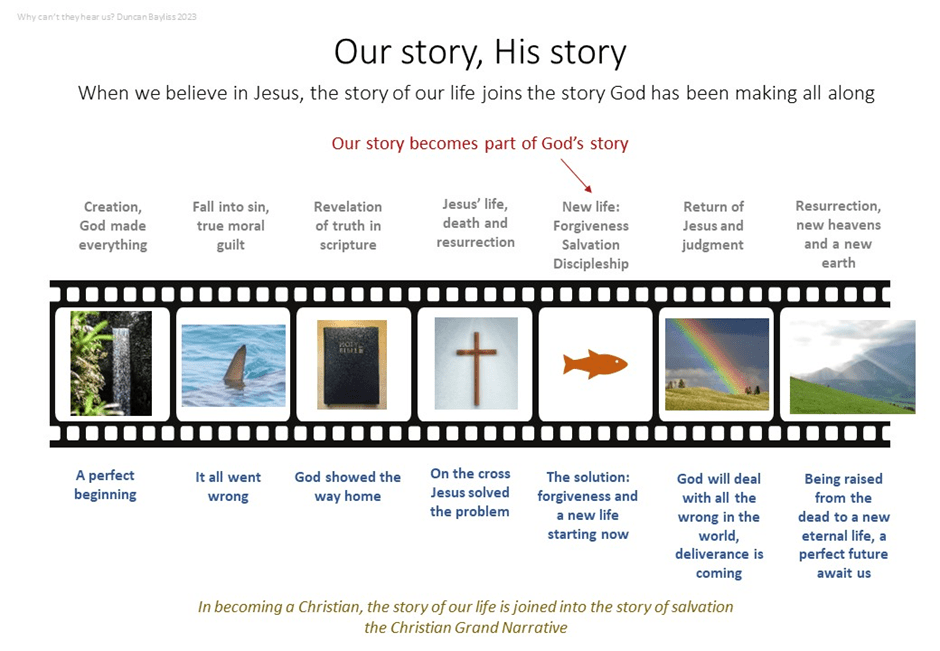
For example, one of the most common reasons for not believing Christianity is credible is that secular culture indoctrinates people with a belief in evolution as an unassailable fact from an early age. Then, in contrast Christianity appears to make no sense compared to the apparently reliable facts they have been told. We can show however, that evolution has serious problems explaining life as we know it and we can share convincing evidence that there must be an ultimate designer and creator, God. You can read more on pre-evangelism in the free Pdf: Why can’t they hear us? (Available on this website)
So, to sum up. What we used to do for evangelism doesn’t work well any more. We desperately need to find new ways to communicate effectively with secular people. That means dealing with their world-view and the presuppositions they hold that act as a block between them and faith. We can’t avoid doing that rigorously and that means developing new materials to share and new training for the church in reaching out to secular society.
At the same time, we will always need to be aware that information alone does not make people Christians. Evidence and arguments are not enough to persuade most people. They have an important place as we help non-believers build a new foundation for their entire way of understanding themselves and the world around them, but secular people also need much more.
To come to faith in Jesus most secular people will need to encounter at least the following:
1 Solid evidence that Christian faith is reasonable and not a leap in the dark
2 Loving, patient, friendly, Christians who are part of a welcoming supportive Christian community
3 The truth of the good news about Jesus as Lord and Saviour, and they will typically need to hear it many times in different ways for it to sink in
4 A personal experience of the deep conviction of the Holy Spirit that Jesus is alive and loves them
They may well also need:
5 Emotional and psychological healing and possibly deliverance from spiritual oppression
6 Time to experience the reality of faith in action while they build up their understanding of what it means to be a disciple of Jesus
Ellen White wrote in a different cultural context over 100 years ago, where most people in Europe and North America had the framework of a Christian world-view that could be appealed to and built upon. We no longer have that luxury. Yet what she cautioned then still seems applicable now.
“The servants of the Lord have trusted too much to the strength of argument, and have not had that firm reliance upon God which they should have. I saw that the mere argument of the truth will not move souls to take a stand with the remnant; for the truth is unpopular. The servants of God must have the truth in the soul. Said the angel: “They must get it warm from glory, carry it in their bosoms, and pour it out in the warmth and earnestness of the soul to those that hear.” A few that are conscientious are ready to decide from the weight of evidence; but it is impossible to move many merely with a theory of the truth. There must be power to attend the truth, a living testimony to move them.” Ellen G. White Testimony for the church, Number one. https://m.egwwritings.org/en/book/12674.1#0
Effective evangelism is not a business programme or a marketing campaign. It is more than we can manage to do on our own. But we are called to do our part and study how to communicate truth effectively and how to counter the objections Satan has built up in secular culture that get in the way of knowing and responding to the truth about Jesus as Lord and Saviour. But that thoughtful effort must be driven by loving Christians and churches living out what they believe, showing the power of God to transform lives.
Finally, it is important to remember, as noted earlier, that as young people in Adventist churches experience the pull of secular culture, they will find it very hard to resist its attraction unless we can respond directly and credibly to the ideas that underpin secularism. If we don’t do that, not only will we not see people from non-churched backgrounds joining us, we will continue to see our children leave the faith. In good conscience we cannot step back and just watch that happen.
Christmas with Jesus
Duncan Bayliss 2024
A decorated tree, Christmas music, over indulging in festive food and gifts, what does Christmas mean to you? What is the point of it? Is there any value in its religious traditions and church services? Is there anything we can find in Christmas that is of lasting value? Does Jesus have a place in your Christmas?

Christmas means different things to different people. It has become swamped with traditions, with Christmas food and endlessly repeated music. It has become a celebration of consumerism. Some of us cherish seeing family and others dread exactly that! But what does it mean? What is the point of Christmas? To answer that question, we must step back and consider what religion does in people’s lives. Why do people “do” religion at all?
There is a problem that all religion has. If people worship a god similar to the ancient Greek or Roman gods then they might be relatable with their human-like form and foibles, but none of them is infinitely powerful. Their very human qualities limit them.
If a religion offers an infinite, all powerful, but distant god, then he remains unreachable. How do we relate to such a God in our weakness? The gulf between us and a distant infinite God seems too great for us to reach across.
There is another problem with religion. Religion in most forms is basically about how we as human beings can get something out of god or the gods. It typically follows a formula which in essence is: do this or that to gain favour and thus get what you want. Or, follow these rules and be rewarded with heaven or eternity. This basic formula holds true across an incredible number of religions. Human effort is somehow supposed to appease or win the favour of god or the gods for our benefit, either right now or at some future day of reckoning.
Yet this leaves us with an unresolvable uncertainty. If religion is built on the basis of human effort, then we can never rest and never have certainty that we have done enough. How can we know if we have followed the rules well enough? Will our efforts have worked? There is no way out of that dilemma.
What if rather than starting with us and what we can do, God took the initiative? A different problem then presents itself. How could God who is powerful enough to make everything that exists, make himself comprehensible to the people he has made?
“In the beginning was the word and the word was with God and the word was God. He was with God in the beginning. Through him all things were made… The word became flesh and made his dwelling among us.” The Gospel of John 1:1-3,14
This is the real story of Christmas, this is the genius of Christianity. God stepped into our world and began to work out the problem of suffering and pain by presenting himself in human form and living a life like ours.
It might sound too strange to be true, but as the life of Jesus of Nazareth unfolded the divinity of God was revealed in the life of a man. Here is God who is infinite, now made personal and relatable. The life he lived, the people he healed, and all that he taught amplified what God is really like. Jesus himself said,
“Anyone who has seen me has seen the Father.” The gospel of John 14:9
That life culminated in the most cruel and tragic death possible; though innocent he was unjustly executed, in fact crucified, rejected by his own people, abandoned by his friends, rejected by the religious authorities of his day.
In the life of Jesus, God is no longer distant, stern, unreachable. Now he is close, suffering alongside us. He is still the infinite creator of all that exists, yet he is humble enough to be born in a peasant village to unheard of parents. This is the King of the Universe stepping into the humblest of ordinary lives. He revealed more of himself as he interacted with ordinary people. And finally, he showed himself all powerful, by rising from the dead after his undeserved execution. His promise to give a new eternal life to those who trust him is then credible. If death cannot hold him, then he is powerful enough to help you.
This is the miracle and wonder of Christmas. God did what we cannot do, he bridged the gap between the divine and the human. He took the initiative. Jesus is Immanuel, which means God with us.
The real gift of Christmas is that Jesus shows us that God is the God who cares, but also the God who dares to step into our rebellious world to lead us back to lasting hope.
Christmas is much more than a story of a baby in a manger. It is the beginning of the greatest life ever lived. It is the way that God has shown all people, for all time, that he is approachable, knowable, patient and kind, yet still infinitely powerful.
Christmas is a miracle of God’s initiative. Why not find out more about the life that Jesus lived and what was really being communicated in that strange birth where God embodied himself in human form?
“Ask and it will be given to you; seek and you will find; knock and the door will be opened to you.” The gospel of Matthew 7:7
Duncan Bayliss
 The Possibility of Belief